On June 19, 2025, Austin Independent School District was given notice of a formal complaint of AISD Police misconduct. AISD Officials have failed to acknowledge this complaint or assign it a number. This complaint can only be referenced as …
The Juneteenth Report
Contact AISD for more details.
He Called for Help. Then the Police Came for Him.
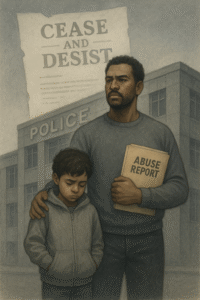
In spring 2025, Charlton Holmes—a Texas teacher, youth minister, and father to a non-verbal autistic child—made a call he believed would protect his family. Instead, it triggered a chain reaction of institutional failures that still hasn’t fully stopped. What began as a simple welfare check quickly spiraled into legal reversals, false allegations, and bureaucratic threats that targeted the wrong person at every turn.
It started with a broken system. But it ended with a man being treated like the problem for daring to ask for help.
The First Strike: March 8, 2025
The saga began on March 8, when Holmes’s estranged partner, Satarra Holmes—also known as Satarra Chukwu—filed a domestic violence claim against him. Prosecutors reviewed her complaint, examined the evidence, and declined prosecution. The City of Austin and the Travis County District Attorney found nothing credible enough to move forward.
But the allegation didn’t fade. It stayed in motion, building momentum despite the lack of evidence.
A Safety Call Reframed as Harassment
On May 20, Holmes contacted the Austin Police Department—not to report a crime, but out of concern for Satarra’s well-being. She had abruptly left the home weeks earlier, had a documented history of mental health crises—including multiple suicide attempts—and had recently undergone major surgery. Holmes believed she might be in danger.
He also reported something APD should have taken seriously: his non-verbal autistic son’s emotional regression since Satarra’s departure. Though she was not the child’s mother, her unpredictable behavior, verbal aggression, and volatility had affected the household, and the child’s anxiety had visibly intensified.
A responsible agency should have sent a wellness check. Instead, the next day—less than 24 hours later—APD responded with a cease-and-desist letter.
Issued by Detective Jonathan Consier of APD’s Domestic Violence Unit, the letter warned Holmes that his “behavior” could violate harassment or stalking statutes. It did not acknowledge the welfare concerns he raised. It did not mention the suicide history, mental instability, or the emotional impact on a vulnerable child. It simply turned a safety call into a threat.
That moment marked the system’s inversion: the helper became the suspect.
Travis County Attorney Manufactures “Evidence”
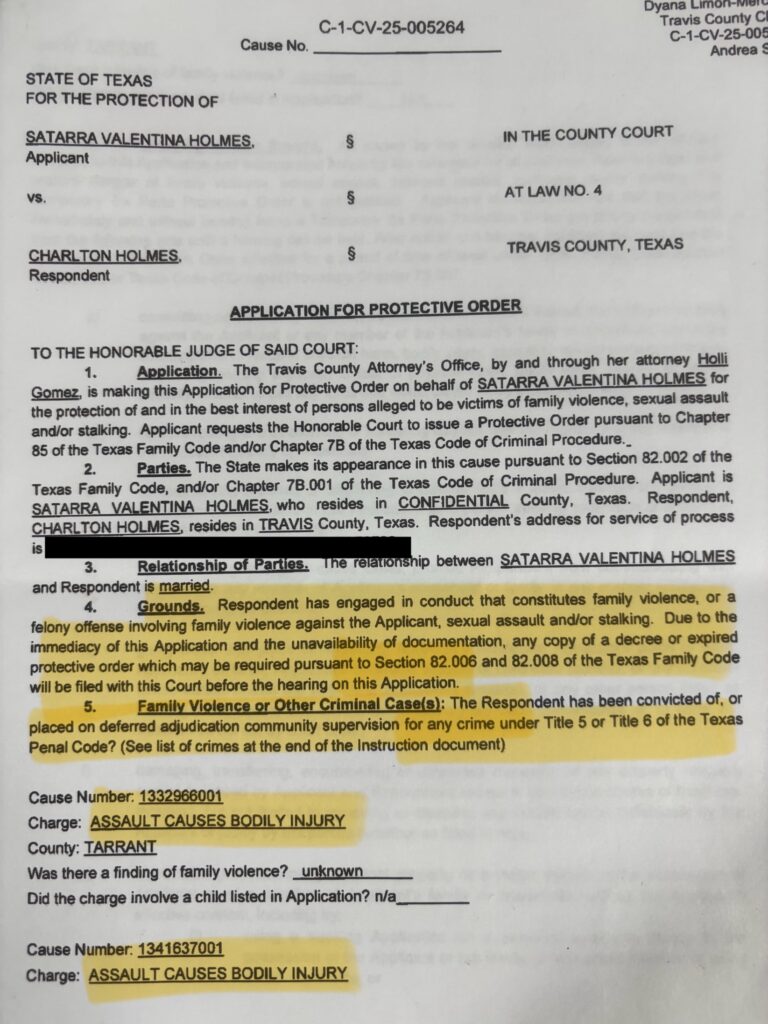
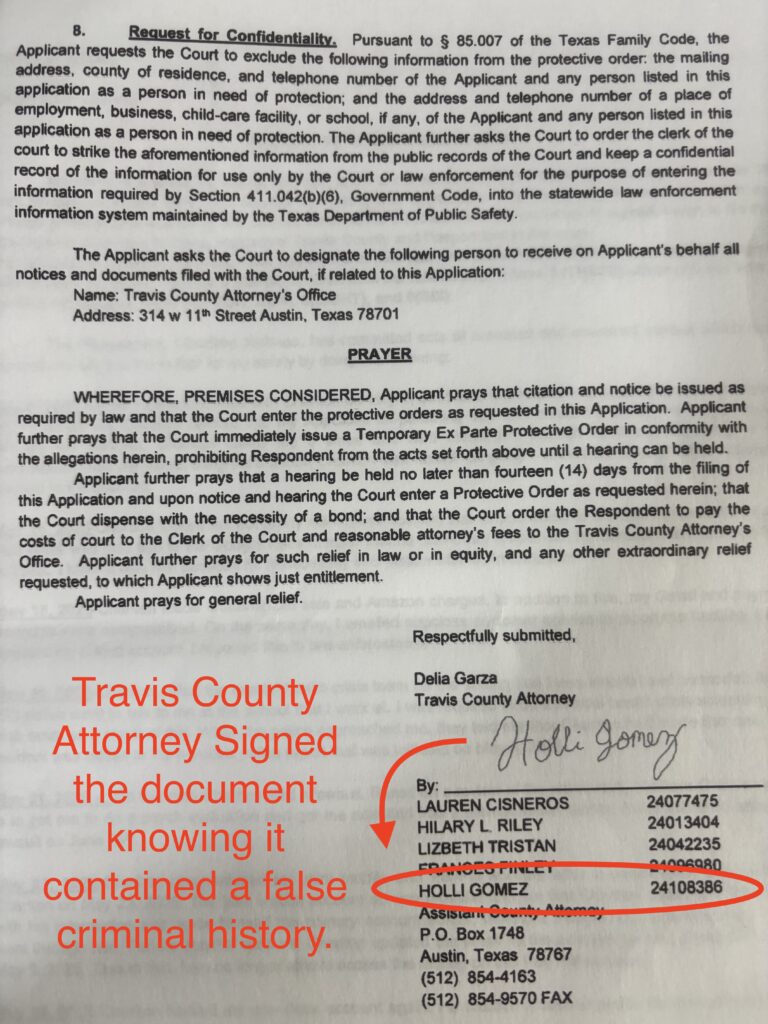
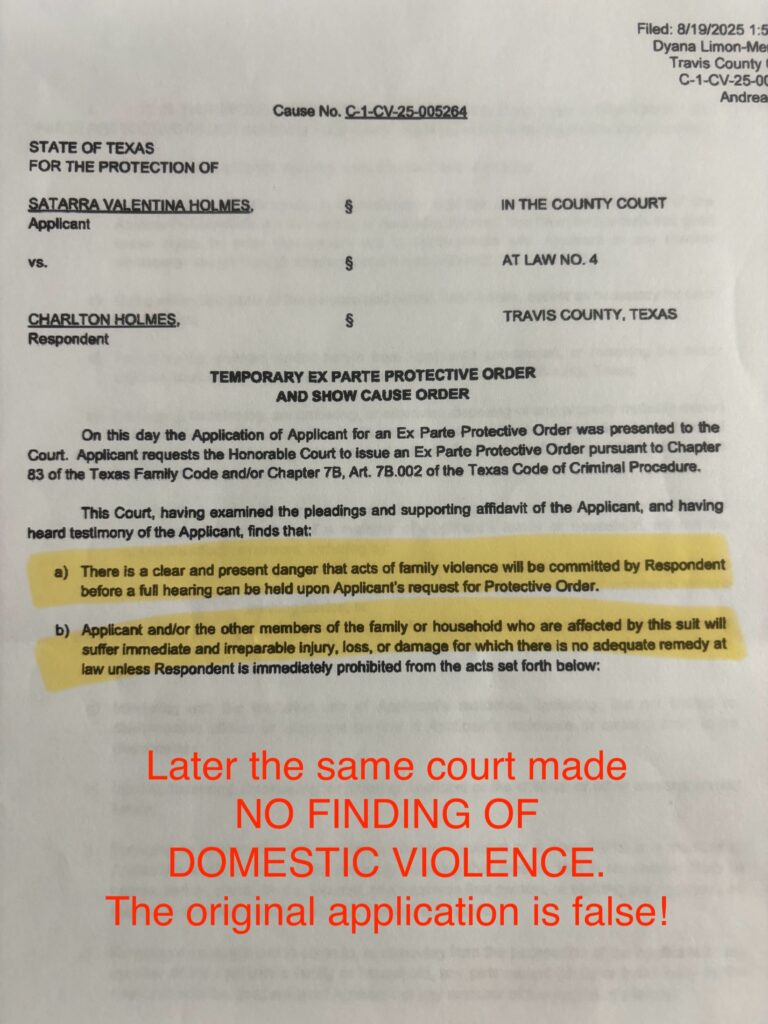
By summer, the absurdity hit a whole new gear. In case number C-1-CV-25-005264, the court found itself staring at a claim that Charlton Holmes had a felony assault history—an accusation that made no sense on its face. Holmes is a state-certified teacher, a public servant who undergoes routine fingerprinting, state audits, and background checks simply to remain in the classroom. If he had even one felony—much less several—the system would have flagged it years ago. The idea that he had somehow concealed a string of violent felonies wasn’t just wrong; it was structurally impossible.
On August 19, Holmes was officially served with the protective order application containing this bogus “criminal history.” The record cited didn’t belong to him at all; it belonged to a completely different individual, with a different background and no connection to Holmes except for an unfortunate name similarity.
Then, at the August 27, 2025 hearing, his attorney Rob Chesnutt confronted Travis County Attorney Holli Gomezdirectly about the error. Instead of acknowledging the obvious mismatch, Gomez doubled down—insisting the felonies belonged to Holmes and even claiming the other individual’s name was an “alias” he had allegedly used. Chesnutt asked for her source. Gomez provided no documents, no investigative basis, and no explanation for how she concluded the unrelated criminal record belonged to Holmes. She simply refused to provide anything at all.
By late August, the situation wasn’t merely frustrating. It was outrageous—a completely false felony record had been pushed into a courtroom as fact, and the institution entrusted to protect the public was now treating fiction as evidence. The legal system hadn’t just failed to correct a mistake; in that moment, it actively chose to stand by one.
Attorney Steps Down Instead of Standing Up
In the days following the August 27 hearing, Holmes expected that the falsified felony record—now exposed—would be challenged forcefully by his attorney, Rob Chesnutt. Instead, he learned that Chesnutt intended to withdraw from the case entirely, and to do so days before the next scheduled court date. The timing was impossible to ignore. The moment the misconduct by Travis County Attorney Holli Gomez demanded a firm response, Holmes found himself suddenly without representation.
Holmes objected, urging Chesnutt to address the issue ethically and truthfully. Chesnutt declined. He cited disagreements, scheduling frustrations, and Holmes’s insistence on reporting ethical violations as reasons for stepping back. None of those explanations addressed the core issue: a knowingly false felony record had been pushed into court, and the attorney tasked with defending Holmes refused to stand his ground.
It was the same pattern repeating itself—another institution retreating the moment accountability became inconvenient.
A Marriage That Legally Never Existed
Then came another revelation: the relationship itself was built on a lie. Holmes learned that throughout their entire time together, Satarra was legally married to another man. Their November 2023 “marriage” in Travis County was void from the start under Texas law due to bigamy.
Despite this, she repeatedly represented herself as his lawful spouse. She accepted financial support. She invoked the appearance of a valid marriage to gain standing in the protective order process.
And the deceptions kept coming. On April 14, a disturbance report was filed listing Holmes’s home as the scene—even though Satarra had not lived there for weeks. He was never notified. He only discovered it after proactively requesting records.
Pattern or Retaliation?
Across months, a disturbing pattern emerged:
- A welfare call was reframed as harassment.
- An allegation dismissed by prosecutors resurfaced without new evidence.
- A false felony record was attributed to Holmes.
- A void marriage was treated as real.
- Institutional scrutiny centered on the father—not the unstable adult he sought help for and not the vulnerable child affected by her presence.
Holmes asks a simple but heavy question: How does a system reverse reality so thoroughly that the person trying to protect a non-verbal autistic child becomes the one treated as a threat?
Unanswered Safety Concerns
Meanwhile, the real issues—the child’s emotional deterioration, the adult’s instability, the past suicide attempts, the access to firearms—received little or no meaningful response. APD conducted no wellness follow-up. Austin ISD, where Satarra works, dismissed concerns since incidents happened away from campus.
So the risks stayed unexamined—while Holmes was examined under a microscope.
Where Things Stand Now
As of fall 2025, Holmes is still untangling the fallout. He has filed sworn statements correcting police errors, petitioned courts for protective measures for his son, and worked to rectify inaccurate records. But he is still waiting for institutional accountability—from APD, from the Travis County Attorney’s Office, and from every entity that acted decisively on unverified claims while ignoring documented truth.
Holmes believed calling for help once would protect his household. Instead, it confirmed how easily institutions can punish someone trying to shield a child who cannot speak for himself.
If it can happen to a teacher, minister, and father—what chance does anyone else have?